nova Session: Policy Update on Circular Economy for the Chemicals and Materials Sector
Discover how concentrated solar power and biomass pyrolysis are shaping the future of renewable materials production and energy generation!
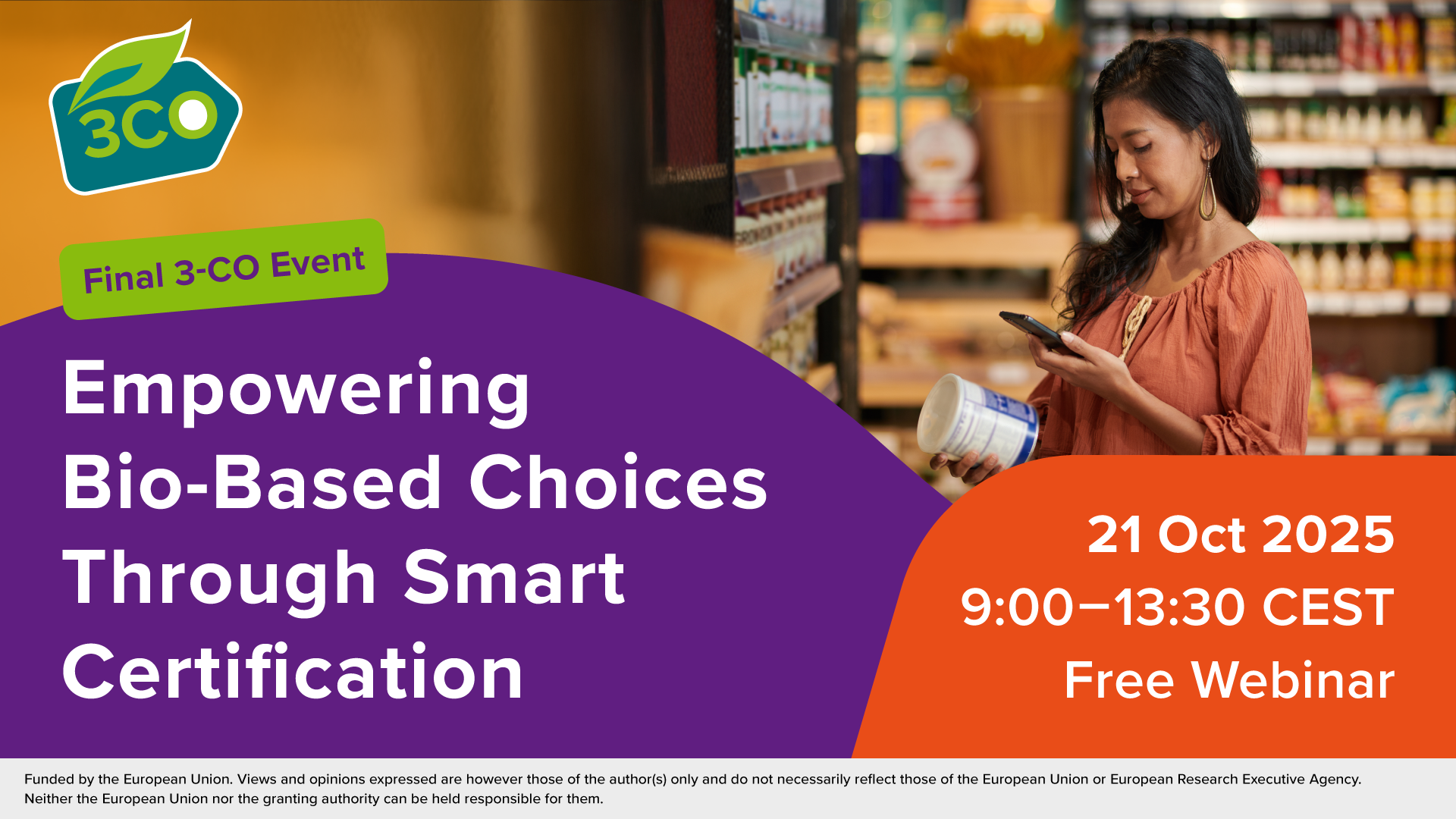
This upcoming webinar by the EU funded 3-CO project will showcase good practice examples of social innovation from all across Europe to inspire sustainable change.
Digital solutions are set to boost the European bioeconomy by providing critical information on feedstock tracking, sustainability, and certification for bio-based products.
To showcase these advances, a free webinar hosted by Horizon Europe projects 3-CO and BioReCer will introduce several innovative digital tools.
Many of the products consumers purchase display eco-labels and are wrapped in promises of sustainability, bio-based content, or fair and ethical production conditions. The messages and criteria behind these labels and certification schemes often remain unclear. To simplify and decode these messages, the EU-funded research project 3-CO (Concise Consumer Communication through Robust Labels for Biobased Systems) focuses on improving how certification schemes and eco-labels communicate with consumers.
The BioReCer (Biological Resources Certifications Schemes) project has developed a framework for assessing the sustainability and circularity of biological resources, identified indicators of circularity, as well as guidelines for integrating these into established certification schemes. In addition, a Standardisation Toolkit was developed, which is a comprehensive online database designed to support professionals in the bio-based industry, as well as recommendations for the valorisation and use of biological feedstock propose integration of BioReCer findings into policy.
Lyocell, a material made from cellulose, is gaining strong attention in the textile industry for its strength, softness, and sustainable production. As the textile industry increasingly prioritises circularity and sustainability, Lyocell 2.0 offers promising solutions through balanced high-quality performance combined with environmental responsibility, while also standing out for its recyclability and versatility.
On 13 November 2025, 13:00-14:30 CEST, nova-Institute will host the first ever nova talk — an interactive online-discussion format offering in-depth discussions on cellulose fibre innovation. This event will bring together internationally recognised experts Dr Asta Partanen (nova-Institute), Philipp Köhler (Thuringian Institute for Textile and Plastics Research Rudolstadt e.V.  – TITK), and Manuel Steiner (LIST Technology AG) to explore next generation cellulose fibres from multiple perspectives.
The BioReCer (Biological Resources Certifications Schemes) project has developed a framework for assessing the sustainability and circularity of biological resources, identified indicators of circularity, as well as guidelines for integrating these into established certification schemes. In addition, a Standardisation Toolkit was developed, which is a comprehensive online database designed to support professionals in the bio-based industry, as well as recommendations for the valorisation and use of biological feedstock propose integration of BioReCer findings into policy.
All you want to know about advanced recycling technologies and renewable chemicals, building-blocks, monomers, and polymers based on recycling: Hear about it at the Advanced Recycling Conference (ARC).
nova Session: Latest nova Market and Trend Reports on Alternative Naphtha, Advanced Recycling, Bio-based Polymers and Bioeconomy in China Hosts: Michael Carus, Lars Krause, Pia Skoczinski, Gillian Tweddle (all nova-institute) 8 December from 14:00 to 15:30h CET (online) - free of charge In this upcoming nova Session, a free webinar, the latest insights from four …
Unlocking the Potential of Renewable Carbon from Biomass, CCU and Recycling. Artificial intelligence (AI) is no longer just a technological trend; it is a transformative force that is accelerating the transition from fossil fuels to renewable carbon sources in the chemical and materials industry. This represents one of the greatest industrial challenges since the beginning of the industrial revolution, requiring the most advanced digital solutions available. AI is emerging as the key enabler of this transformation.
The CO2-based Fuels and Chemicals Conference has successfully established itself as an international and unique meeting and networking ground for the entire Carbon Capture and Utilisation (CCU) and Power-to-X industry and its customers. The upcoming 14th edition of the conference will take place on 28–29 April 2026, Cologne, Germany as a hybrid event. Organiser nova-Institute expects over 250 leading international experts in the field of CCU, green hydrogen production and Power-to-X. Once more the event will showcase the latest innovations and most important developments in the fast-growing field of Carbon Capture and Utilisation with plenty of opportunities to network.